Cannot Assign to Read Only Property 'backgroundcolor' of Object '#<object>'
This browser is no longer supported.
Upgrade to Microsoft Edge to take reward of the latest features, security updates, and technical support.
Xamarin.Forms RadioButton
 Download the sample
The Xamarin.Forms RadioButton is a type of button that allows users to select i option from a fix. Each choice is represented by one radio button, and you tin just select one radio button in a group. By default, each RadioButton displays text:

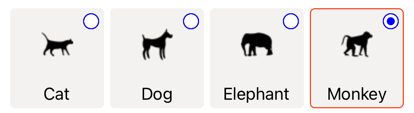
However, on some platforms a RadioButton can display a View, and on all platforms the appearance of each RadioButton can be redefined with a ControlTemplate:
The RadioButton control defines the following backdrop:
-
Content, of blazonobject, which defines thecordorViewto be displayed by theRadioButton. -
IsChecked, of typebool, which defines whether theRadioButtonis checked. This property uses aTwoWaybinding, and has a default value offalse. -
GroupName, of typestring, which defines the name that specifies whichRadioButtoncontrols are mutually sectional. This belongings has a default value ofnull. -
Value, of blazonobject, which defines an optional unique value associated with theRadioButton. -
BorderColor, of typeColor, which defines the border stroke colour. -
BorderWidth, of typedouble, which defines the width of theRadioButtonedge. -
CharacterSpacing, of blazondouble, which defines the spacing between characters of any displayed text. -
CornerRadius, of typeint, which defines the corner radius of theRadioButton. -
FontAttributes, of blazonFontAttributes, which determines text style. -
FontFamily, of typecord, which defines the font family. -
FontSize, of typedouble, which defines the font size. -
TextColor, of typeColor, which defines the colour of any displayed text. -
TextTransform, of typeTextTransform, which defines the casing of whatever displayed text.
These properties are backed by BindableProperty objects, which means that they can be targets of data bindings, and styled.
The RadioButton control too defines a CheckedChanged outcome that's fired when the IsChecked holding changes, either through user or programmatic manipulation. The CheckedChangedEventArgs object that accompanies the CheckedChanged issue has a single property named Value, of type bool. When the event is fired, the value of the CheckedChangedEventArgs.Value property is set to the new value of the IsChecked holding.
RadioButton grouping can be managed by the RadioButtonGroup form, which defines the following attached properties:
-
GroupName, of typestring, which defines the group name forRadioButtonobjects in aLayout<View>. -
SelectedValue, of typeobject, which represents the value of the checkedRadioButtonobject within aLayout<View>group. This fastened property uses aTwoWaybounden by default.
For more information most the GroupName fastened property, see Group RadioButtons. For more information most the SelectedValue fastened belongings, see Answer to RadioButton state changes.
Create RadioButtons
The appearance of a RadioButton is defined by the type of data assigned to the RadioButton.Content property:
- When the
RadioButton.Contentbelongings is assigned acord, it will be displayed on each platform, horizontally aligned side by side to the radio button circumvolve. - When the
RadioButton.Contentis assigned aView, information technology will be displayed on supported platforms (iOS, UWP), while unsupported platforms will fallback to a string representation of theViewobject (Android). In both cases, the content is displayed horizontally aligned next to the radio push circumvolve. - When a
ControlTemplateis practical to aRadioButton, aViewtin exist assigned to theRadioButton.Contentproperty on all platforms. For more data, see Redefine RadioButton appearance.
Display cord-based content
A RadioButton displays text when the Content holding is assigned a string:
<StackLayout> <Characterization Text="What's your favorite animal?" /> <RadioButton Content="Cat" /> <RadioButton Content="Dog" /> <RadioButton Content="Elephant" /> <RadioButton Content="Monkey" IsChecked="true" /> </StackLayout> In this example, RadioButton objects are implicitly grouped within the same parent container. This XAML results in the appearance shown in the post-obit screenshots:

Display arbitrary content
On iOS and UWP, a RadioButton can display arbitrary content when the Content holding is assigned a View:
<StackLayout> <Label Text="What'southward your favorite animal?" /> <RadioButton> <RadioButton.Content> <Image Source="cat.png" /> </RadioButton.Content> </RadioButton> <RadioButton> <RadioButton.Content> <Image Source="dog.png" /> </RadioButton.Content> </RadioButton> <RadioButton> <RadioButton.Content> <Paradigm Source="elephant.png" /> </RadioButton.Content> </RadioButton> <RadioButton> <RadioButton.Content> <Image Source="monkey.png" /> </RadioButton.Content> </RadioButton> </StackLayout> In this example, RadioButton objects are implicitly grouped inside the same parent container. This XAML results in the appearance shown in the post-obit screenshots:

On Android, RadioButton objects volition display a string-based representation of the View object that'due south been set every bit content:

Associate values with RadioButtons
Each RadioButton object has a Value property, of type object, which defines an optional unique value to associate with the radio push button. This enables the value of a RadioButton to exist different to its content, and is particularly useful when RadioButton objects are displaying View objects.
The following XAML shows setting the Content and Value properties on each RadioButton object:
<StackLayout> <Characterization Text="What'south your favorite animal?" /> <RadioButton Value="Cat"> <RadioButton.Content> <Image Source="cat.png" /> </RadioButton.Content> </RadioButton> <RadioButton Value="Canis familiaris"> <RadioButton.Content> <Image Source="dog.png" /> </RadioButton.Content> </RadioButton> <RadioButton Value="Elephant"> <RadioButton.Content> <Image Source="elephant.png" /> </RadioButton.Content> </RadioButton> <RadioButton Value="Monkey"> <RadioButton.Content> <Paradigm Source="monkey.png" /> </RadioButton.Content> </RadioButton> </StackLayout> In this example, each RadioButton has an Image every bit its content, while besides defining a string-based value. This enables the value of the checked radio push to exist hands identified.
Group RadioButtons
Radio buttons work in groups, and there are three approaches to grouping radio buttons:
- Place them inside the same parent container. This is known as implicit grouping.
- Set up the
GroupNamebelongings on each radio button in the group to the same value. This is known as explicit grouping. - Gear up the
RadioButtonGroup.GroupNameattached property on a parent container, which in plough sets theGroupNameproperty of whateverRadioButtonobjects in the container. This is also known as explicit grouping.
Important
RadioButton objects don't take to belong to the same parent to be grouped. They are mutually exclusive provided that they share a group proper noun.
Explicit grouping with the GroupName holding
The following XAML instance shows explicitly group RadioButton objects by setting their GroupName properties:
<Label Text="What's your favorite colour?" /> <RadioButton Content="Red" GroupName="colors" /> <RadioButton Content="Dark-green" GroupName="colors" /> <RadioButton Content="Blue" GroupName="colors" /> <RadioButton Content="Other" GroupName="colors" /> In this example, each RadioButton is mutually exclusive considering it shares the same GroupName value.
Explicit grouping with the RadioButtonGroup.GroupName attached property
The RadioButtonGroup grade defines a GroupName fastened property, of blazon string, which can be assault a Layout<View> object. This enables any layout to exist turned into a radio button group:
<StackLayout RadioButtonGroup.GroupName="colors"> <Label Text="What'south your favorite color?" /> <RadioButton Content="Red" /> <RadioButton Content="Green" /> <RadioButton Content="Blue" /> <RadioButton Content="Other" /> </StackLayout> In this instance, each RadioButton in the StackLayout volition accept its GroupName property set to colors, and will be mutually exclusive.
Note
When a Layout<View> object that sets the RadioButtonGroup.GroupName attached property contains a RadioButton that sets its GroupName holding, the value of the RadioButton.GroupName property will take precedence.
Respond to RadioButton land changes
A radio push has 2 states: checked or unchecked. When a radio button is checked, its IsChecked holding is truthful. When a radio button is unchecked, its IsChecked property is false. A radio push can exist cleared past borer some other radio button in the same group, only information technology cannot be cleared by tapping it once again. However, yous can clear a radio button programmatically past setting its IsChecked property to false.
Respond to an event firing
When the IsChecked property changes, either through user or programmatic manipulation, the CheckedChanged event fires. An event handler for this event can be registered to reply to the modify:
<RadioButton Content="Red" GroupName="colors" CheckedChanged="OnColorsRadioButtonCheckedChanged" /> The code-backside contains the handler for the CheckedChanged effect:
void OnColorsRadioButtonCheckedChanged(object sender, CheckedChangedEventArgs e) { // Perform required operation } The sender argument is the RadioButton responsible for this issue. Y'all can use this to admission the RadioButton object, or to distinguish between multiple RadioButton objects sharing the same CheckedChanged event handler.
Respond to a belongings change
The RadioButtonGroup class defines a SelectedValue attached property, of blazon object, which can be set on a Layout<View> object. This attached belongings represents the value of the checked RadioButton within a grouping defined on a layout.
When the IsChecked holding changes, either through user or programmatic manipulation, the RadioButtonGroup.SelectedValue fastened belongings as well changes. Therefore, the RadioButtonGroup.SelectedValue attached holding can be data spring to a property that stores the user's selection:
<StackLayout RadioButtonGroup.GroupName="{Bounden GroupName}" RadioButtonGroup.SelectedValue="{Binding Pick}"> <Label Text="What's your favorite fauna?" /> <RadioButton Content="Cat" Value="Cat" /> <RadioButton Content="Dog" Value="Dog" /> <RadioButton Content="Elephant" Value="Elephant" /> <RadioButton Content="Monkey" Value="Monkey"/> <Label x:Name="animalLabel"> <Label.FormattedText> <FormattedString> <Span Text="You have chosen:" /> <Span Text="{Binding Selection}" /> </FormattedString> </Label.FormattedText> </Characterization> </StackLayout> In this instance, the value of the RadioButtonGroup.GroupName attached property is set past the GroupName holding on the binding context. Similarly, the value of the RadioButtonGroup.SelectedValue attached property is prepare by the Selection holding on the binding context. In addition, the Selection property is updated to the Value property of the checked RadioButton.
RadioButton visual states
RadioButton objects have Checked and Unchecked visual states that can be used to initiate a visual change when a RadioButton is checked or unchecked.
The following XAML example shows how to define a visual land for the Checked and Unchecked states:
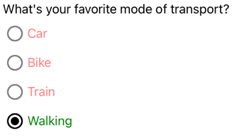
<ContentPage ...> <ContentPage.Resources> <Style TargetType="RadioButton"> <Setter Property="VisualStateManager.VisualStateGroups"> <VisualStateGroupList> <VisualStateGroup x:Proper noun="CheckedStates"> <VisualState ten:Name="Checked"> <VisualState.Setters> <Setter Property="TextColor" Value="Dark-green" /> <Setter Property="Opacity" Value="one" /> </VisualState.Setters> </VisualState> <VisualState x:Proper name="Unchecked"> <VisualState.Setters> <Setter Property="TextColor" Value="Red" /> <Setter Property="Opacity" Value="0.5" /> </VisualState.Setters> </VisualState> </VisualStateGroup> </VisualStateGroupList> </Setter> </Way> </ContentPage.Resources> <StackLayout> <Label Text="What's your favorite mode of send?" /> <RadioButton Content="Machine" /> <RadioButton Content="Bike" /> <RadioButton Content="Train" /> <RadioButton Content="Walking" /> </StackLayout> </ContentPage> In this case, the implicit Style targets RadioButton objects. The Checked VisualState specifies that when a RadioButton is checked, its TextColor belongings will be ready to dark-green with an Opacity value of 1. The Unchecked VisualState specifies that when a RadioButton is in a unchecked state, its TextColor property will be set to red with an Opacity value of 0.5. Therefore, the overall event is that when a RadioButton is unchecked it'southward red and partially transparent, and is dark-green without transparency when it's checked:
For more information about visual states, see Xamarin.Forms Visual Country Manager.
Redefine RadioButton advent
By default, RadioButton objects use platform renderers to utilize native controls on supported platforms. However, RadioButton visual structure can be redefined with a ControlTemplate, then that RadioButton objects accept an identical appearance on all platforms. This is possible because the RadioButton class inherits from the TemplatedView class.
The following XAML shows a ControlTemplate that can be used to redefine the visual structure of RadioButton objects:
<ContentPage ...> <ContentPage.Resources> <ControlTemplate x:Fundamental="RadioButtonTemplate"> <Frame BorderColor="#F3F2F1" BackgroundColor="#F3F2F1" HasShadow="Imitation" HeightRequest="100" WidthRequest="100" HorizontalOptions="Start" VerticalOptions="Showtime" Padding="0"> <VisualStateManager.VisualStateGroups> <VisualStateGroupList> <VisualStateGroup 10:Name="CheckedStates"> <VisualState x:Proper name="Checked"> <VisualState.Setters> <Setter Holding="BorderColor" Value="#FF3300" /> <Setter TargetName="bank check" Property="Opacity" Value="1" /> </VisualState.Setters> </VisualState> <VisualState x:Name="Unchecked"> <VisualState.Setters> <Setter Belongings="BackgroundColor" Value="#F3F2F1" /> <Setter Property="BorderColor" Value="#F3F2F1" /> <Setter TargetName="check" Belongings="Opacity" Value="0" /> </VisualState.Setters> </VisualState> </VisualStateGroup> </VisualStateGroupList> </VisualStateManager.VisualStateGroups> <Grid Margin="4" WidthRequest="100"> <Filigree WidthRequest="18" HeightRequest="18" HorizontalOptions="End" VerticalOptions="First"> <Ellipse Stroke="Blue" Fill="White" WidthRequest="16" HeightRequest="16" HorizontalOptions="Center" VerticalOptions="Centre" /> <Ellipse x:Proper name="cheque" Fill up="Bluish" WidthRequest="8" HeightRequest="8" HorizontalOptions="Middle" VerticalOptions="Center" /> </Filigree> <ContentPresenter /> </Grid> </Frame> </ControlTemplate> <Mode TargetType="RadioButton"> <Setter Belongings="ControlTemplate" Value="{StaticResource RadioButtonTemplate}" /> </Style> </ContentPage.Resource> <!-- Folio content --> </ContentPage> In this case, the root chemical element of the ControlTemplate is a Frame object that defines Checked and Unchecked visual states. The Frame object uses a combination of Grid, Ellipse, and ContentPresenter objects to define the visual structure of a RadioButton. The example as well includes an implicit fashion that will assign the RadioButtonTemplate to the ControlTemplate holding of any RadioButton objects on the folio.
The following XAML shows RadioButton objects that consume the ControlTemplate via the implicit way:
<StackLayout> <Characterization Text="What'southward your favorite beast?" /> <StackLayout RadioButtonGroup.GroupName="animals" Orientation="Horizontal"> <RadioButton Value="True cat"> <RadioButton.Content> <StackLayout> <Paradigm Source="cat.png" HorizontalOptions="Middle" VerticalOptions="CenterAndExpand" /> <Label Text="Cat" HorizontalOptions="Center" VerticalOptions="End" /> </StackLayout> </RadioButton.Content> </RadioButton> <RadioButton Value="Dog"> <RadioButton.Content> <StackLayout> <Image Source="dog.png" HorizontalOptions="Center" VerticalOptions="CenterAndExpand" /> <Label Text="Domestic dog" HorizontalOptions="Center" VerticalOptions="End" /> </StackLayout> </RadioButton.Content> </RadioButton> <RadioButton Value="Elephant"> <RadioButton.Content> <StackLayout> <Image Source="elephant.png" HorizontalOptions="Middle" VerticalOptions="CenterAndExpand" /> <Label Text="Elephant" HorizontalOptions="Center" VerticalOptions="Stop" /> </StackLayout> </RadioButton.Content> </RadioButton> <RadioButton Value="Monkey"> <RadioButton.Content> <StackLayout> <Prototype Source="monkey.png" HorizontalOptions="Center" VerticalOptions="CenterAndExpand" /> <Characterization Text="Monkey" HorizontalOptions="Heart" VerticalOptions="Stop" /> </StackLayout> </RadioButton.Content> </RadioButton> </StackLayout> </StackLayout> In this example, the visual construction defined for each RadioButton is replaced with the visual structure defined in the ControlTemplate, and so at runtime the objects in the ControlTemplate get part of the visual tree for each RadioButton. In improver, the content for each RadioButton is substituted into the ContentPresenter divers in the command template. This results in the following RadioButton appearance:

For more data about control templates, see Xamarin.Forms control templates.
Disable a RadioButton
Sometimes an application enters a state where a RadioButton being checked is not a valid operation. In such cases, the RadioButton can exist disabled by setting its IsEnabled holding to false.
- RadioButton Demos (sample)
- Xamarin.Forms Push
- Xamarin.Forms Visual Country Manager
Feedback
bernsteinchme1960.blogspot.com
Source: https://docs.microsoft.com/en-us/xamarin/xamarin-forms/user-interface/radiobutton
0 Response to "Cannot Assign to Read Only Property 'backgroundcolor' of Object '#<object>'"
Enviar um comentário